MAY 2003
John was still recovering in hospital in Southport in May so Paul was
left to look after the bees by himself.
His inspection of the bees during the first week in May revealed several
large queen cells (cup-shaped cells ripe and ready to hatch) in Hive 4
- this colony was about to swarm. He didn't want any swarms while there
was nobody around to help so he destroyed the queen cells and consulted
the books to find out what to do next, He was also travelling back and
forth between York and Southport to visit John and with nobody near to
check them regularly the hives could swarm at any time - he couldn't afford
having any swarms while we were away.
In the second week in May Paul decided hive 4's colony had become too
powerful to handle safely so he decided to split the colony by creating
an artificial swarm. This means taking the "ripe" queen cells
and some frames of brood with some "nurse" bees out of the hive
and making a new colony.
Hopefully the original hive will not swarm now and the new colony will
unite and raise a new queen.
His inspection on 14th May showed the other main colonies in hives 1,2
and 3 were also making large, "ripe" queen cells!
Oh dear! What shall we do? All these cells were destroyed.
Tuesday, 20th May. John's back home. Hurrah!
But the weather was against us, it was cold and wet all week,
Paul couldn't check the bees.
Oh dear!
If a hive is making queen cells, regular inspections of the colony must
be carried out - it takes nine days for a queen cell to develop. After
that the hive will swarm!
It was Friday, 23rd before Paul could check the bees again, nine days
- was he too late?
Yes, he was!
On Saturday, May 24th hive 3 swarmed into Miss Wright's (our next door
neighbour's) garden.
On Tuesday, 27th hive 2 swarmed into our other neighbour Mr. Cook's garden,
then while Dad and Paul collected that swarm, the bees in Hive 1 decided
to swarm again into Mr, Cook's garden.
It was chaos!
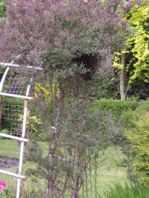
The first swarm settled in Mr Cooks honeysuckle (The same
place as a swarm had landed in 2002).
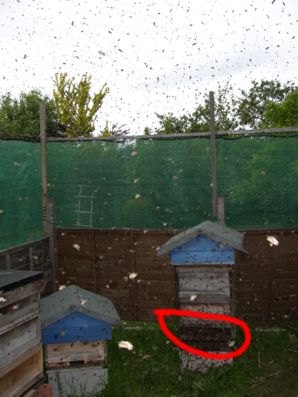
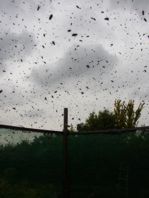
But then hive 1 errupted and the sky was full of bees
This time the bees settled in his apple tree so a step ladder was needed to get them down.
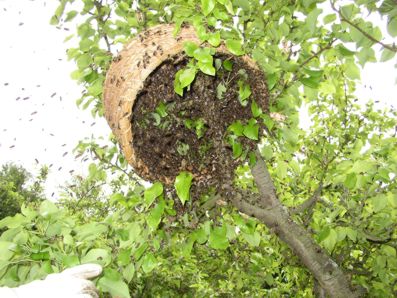
A skep is used for the bees to climb into
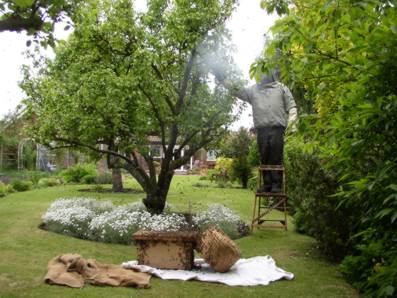
Dad smokes the tree, most bees are now running into the
swarm box in the foreground.
All three captured, boxed swarms were taken Pauls bungalow and hidden
in the back garden - hopefully his neighbour will not know the beehives
are there.
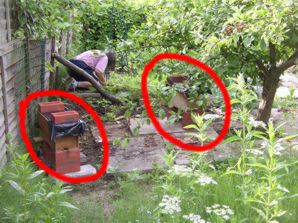
(Lynn tends her veg plot with two swarm boxes hidden under
the plum tree, I hope the neighbour doesn't spot them)
Was that the end of the bees swarming? Oh no....
Wednesday 28th Dad spent most of the day getting rid of bees from the
collected swarm returning to Mr. Cook's garden - maybe Paul's bungalow
isn't far enough away to prevent some of the bees returning to their original
site.
But that still wasn't the end of things!
Paul's neighbour, Gordon Daniels, rang him to say that some bees were
gathering on his fence so Paul hurried back from work thinking that a
swarm had escaped from one of his hives.
It was not one of his colonies however; just a passing swarm, perhaps
from someone else's apiary.
"Bees attract bees", so the saying goes!!
So now Paul has 4 colonies in his garden.
Saturday 31st May. John's back home and the full team of apiarists was
now back together again to inspect the hive colonies.
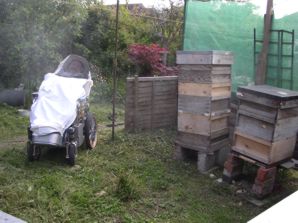
The 3 main hives which had swarmed only needed a quick exammination as
there were less bees to worry about - all the colonies were OK so we left
them alone to rear new queens.
Inspecting the 4 small swarms we found only two of them had queens. The
artificial swarm was one of the colonies which hadn't raised a queen -
perhaps the cold, wet weather had prevented them from producing one,
We decided to unite each of the queenless hives with one that already
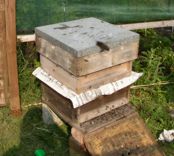
had a queen. To do this we first we sprayed the bees with sugar syrup
and placed a sheet of newspaper over them, then put the other hive box
on top.
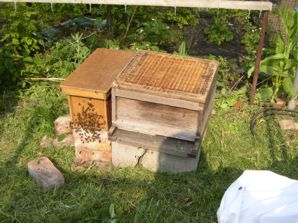
The two hives to be united are side by side
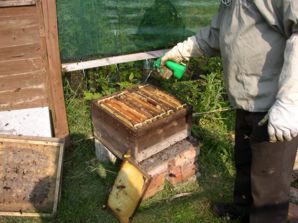
First sugar syrup is sprayed on, then newspaper
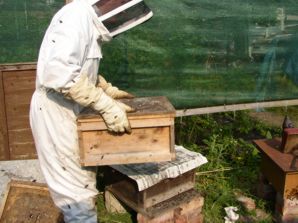
The second hive is put on top and again sprayed with sugar
Hopefully, the bees will eat through the paper, mix with the other colony and clean each other up spreading their odour through the colony without them fighting,