
JUNE 2003
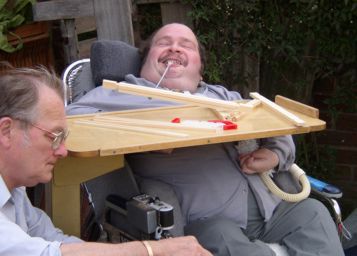
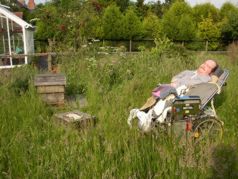
It is good to have John back and part of the team once
again. Here helping dad with some new brood frames
The warm, dry, settled weather of May continued into June and our first inspection of the month on 7th showed the colony in our united hive seems to be doing well so we removed the tattered remnants of newspaper and left the bees to settle down.
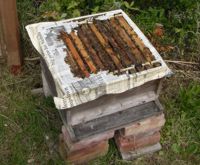
Hive 3 is now quite large being the only colony yet producing honey. The
bees have already filled two supers and started on the third! Something
must be done before this hive falls over!
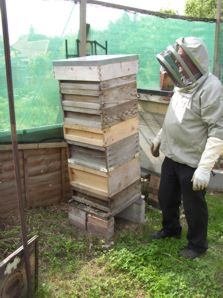
(A massive hive 3)
We placed a "clearer" board between the honey Supers and the brood box. A clearer board has one way "traps" built in so that the bees can only travel downwards, hopefully leaving the honey free of bees. Later on we used a whellbarrow to remove the full supers to bae taken away and stored until our September extraction.
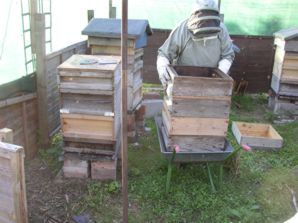
Back at Paul's bungalow only one of the 3 swarms has taken; perhaps the queens had not survived! So he decided to unite all the colonies into one large colony.
The one remaing hive at Pauls bungalow
On 10th June Paul had the unfortunate task of destroying a hive of bees
at Flaxton - the vicious colony from last year had survived and now getting
bigger and more aggressive! That will never do! There are children around
and we do not want them stung.
Drastic action must be taken.
Paul got a cylinder of CO2 and, from a bin liner, he made a tent over
the hive and pumped the CO2 into it, knocking out the bees in the hive.
Later he collected them in a bag and disposed of them. The aim was to
catch the queen and the aggressive flying bees but not to destroy the
hive and the brood. He rerurned to the hive the next day to unite the
swarm box from the bungalow with the now queenless hive - hopefully they
will breed a new, docile colony.
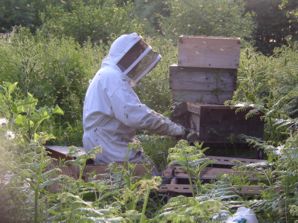
(First the entrance is bunged up)
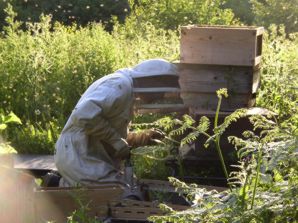
(Then CO2 pumped in to knock them out)
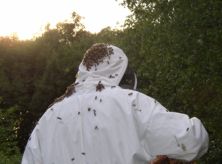
They certainly were angry!
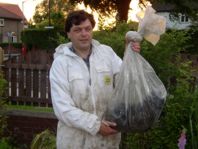
Bagged up and then frozen quickly to destroy them
While all this was happening, a swarm from Monk Avenue landed in Mr. Cook's
garden but it flew off before we could hive it. The same happened the
next day and on the 11th June a massive swarm landed in his garden - it
was far too large for a swarm box so a brood box was used to move it.
He took it straight up to Flaxton. A further colony and a swarm box found
its way to Flaxton: We have far too many bees for a back garden.
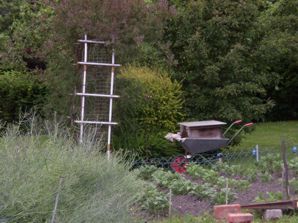
(Swarming back into their favourite honeysuckle tree)
This was too big a swarm to have come from our beehives, but drastic
action was needed as Mr. Cook is getting fed up with swarms.
On 11th June Paul went through every hive destroying all the queen cells
he could find; hive 2 had lots of them - all ripe, ready to emerge!
The original queen must have died and the bees, realising this, have made
lots of queen cells in a hurry to replace her. Paul removed all the queen
cells except one from the hive.
With one of the queen cells he experimented using a "mini-nuc"
- a very small hive used for breeding bees. Just one of the things we'd
bought at the auction of beekeeping equipment last year. It is basically
a hive box into which a young queen bee and a few workers are put together,
hopefully to form the neucleus of a new colony.
But the next day the box was empty - the bees hadn't liked it.
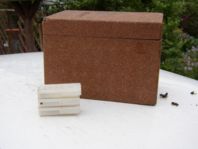
A mini-nuc box... The bees at the front give it scale
To avoid any more chaos with swarms Paul, John and Dad inspected all
the hive colonies at least once every nine days to stop any more queen
cells developing.
The hot weather at the start of the year has been very strange.