
June 2000
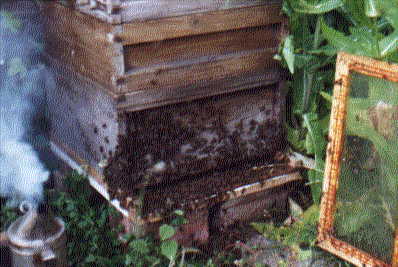
Opening-up hive 1 in early June: We are soon greeted by lots of bees.
(Note the smoker in the left corner).
June began with a routine inspection of our small hive 3 swarm which, much to our delight, seemed to be very healthy. The rate at which the colony was growing pleased us, but we were worried about the lack of stored food that the colony should have. With the hive expanding there should be some food for the grubs. A feeder filled with a sugar solution was therefore placed on the hive. This seemed to do the trick and we were soon able to remove the empty feeder.
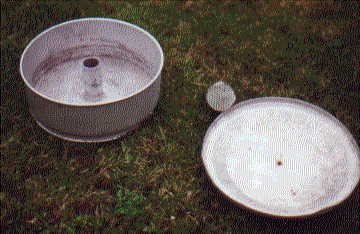
This is the parts of a feeder: A tin with a tube-up the middle that the
bees can pass, a lid to stop them escaping.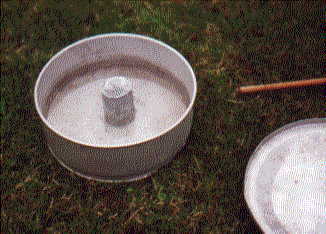
The tin is filled with sugar syrup (2 parts sugar to 1 part water. and a gauze tube is put over the entrance tube to stop the bees from drowning in the syrup. this is then put at the top of the hive
Our routine inspection of hive 1 on 6th June presented us with another very different problem - 6 open Queen cells! (If these are not found and destroyed your bees will swarm unexpectedly). We were just in time! All hive colonies must be checked regularly, queen cells take nine days to from the laying of an egg to being sealed. After that the old queen and most of the workers will swarm to start a new colony elsewhere. Another check on Hive 1, carried out on 14th revealed our problem had increased - 17 queen cells were found and removed from the hive. (From now on during the summer we have to make sure that we inspect at least every nine days to ensure that the colony isn't going to swarm. Searching for, finding and removing lots of queen cells from every frame in a hive can be tedious, but it is essential if we don't want any swarms: Vitally important for us with only three hives and in a built-up urban area).
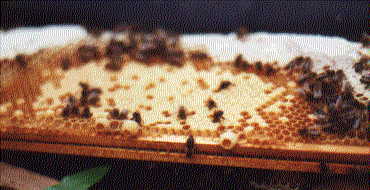
This is a frame laid on its side showing the bottom of
the frame: If you look closely you will see three open queen cells.. They
are getting ready to raise a new queen.
We also found we had trouble with Hive 2 which was still not expanding.
On inspection we discovered 17 queen cells here and most of the bees were
now crowded into the super at the top of the hive. They just wouldn't
move back down into the large brood chamber. What a mess! We didn't know
what to do. Paul wrote to the beekeepers' newsgroup on the Internet asking
for advice....
Hive 3 however was now well fed & beginning to expand and gain strength
again; we found one queen cell.
Our next chance to inspect the bees on Thursday, 22nd June was forced
by lack of time and the inclement weather to be done on a cold, showery,
dismal evening (not the best time to go opening hives and disturbing thousands
of bees). The reason we had to do this was that as we were finding an
increase in the number of queen cells being produced, we have to stop
them getting any idea about swarming, and as we wrote earlier we need
to go and inspect at least every nine days. (British weather or not!
We found and removed 27 queen cells in hive 1. Hive 3 was still expanding
but not very quickly so we decided to transfer a frame of new, young,
healthy grubs from hive 1 to it to encourage it to expand and also to
give more space in our bigger more powerful hive 1.
Our last inspection of June was on Friday 30th. In hive 1 we found 33!
Yes, 33 queen cells. So, to give them more space we put a second super
on top of the hive. There were 19 queen cells in hive 2 and all the bees
were still all crowded in the top box, theories and ideas were now coming
back to Paul from beekeepers on the internet.
In hive 3 we only found 9 queen cells and the colony now going well so
we added a super so that the bees had a bit more room to expand the colony.
Who knows we may even get some honey from our small colony.
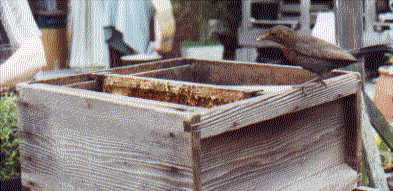
Here is a visitor we had in June. This hive box is one that we set-up
in the garden as a "bait" hive to attract passing swarms of
bees. We put an old frame in the box, but unfortunately I didn't put the
lid on quickly enough. This tame blackbird would visit to pick scraps
off the frame to feed nearby offspring... we didn't really mind, she was
quite tame and entertaining.