
August 2000
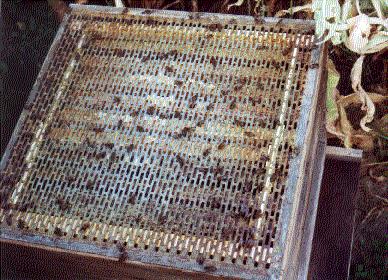
An open hive in early August showing workers clambering through the queen
excluder
August was a relatively quiet month for us apiarists, we were still checking the hives to see that increase in queen cells was being produced and that those we found didn't contain eggs. Otherwise, all that was left for us to do was to speculate about how much honey our bees would produce.
Our weekly inspection of the colonies on Friday 11th August found that
everything seemed to be well with tha bees in Hive 1. The colony had nearly
filled the first super but they had started filling the second before
the first was completely full. We decided to remove the second super to
encourage the bees to fill the first; bees will not return to fill a super
once it has been started. We also removed one full frame from hive 1 our
first honey of the Millenium!
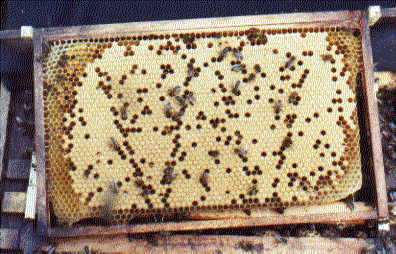
A frame chock full of sealed brood. Note the gaps where the foundation
wires pass looking like a "W"
In Hive 2 we spotted the Queen again. The bees seemed quite active and
the colony was expanding into the brood box so swapping the boxes over
seemed to have done the trick. The bees in Hive 3 now seemed to be equally
as active as the other hives and the colony was now increasing in strength
and there were only about a dozen queen cells for us to remove.
By mid August it was clear that the bees were still producing queen cells.
Paul sent another note to the "Beekeeping" newsgroup again asking
for their advice about them and the inspections.
The replies we received said that unless eggs could be seen in the queen
cells then we could stop worrying about reducing them as it was probably
too late in the season for the bees to swarm, we could reduce the frequency
of the inspections to avoid disturbing them further. We could, at last,
let the bees get on with the job of producing honey!