
June 2004
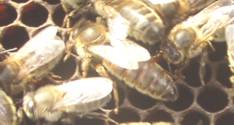
The rare sight of a queenbee
How to deal with all the Flaxton honey. It was the first time we have harvested honey so early in the year - in Spring - and our first attempt at harvesting and extracting Rape Seed honey. So, on the evenings of 2nd and 3rd June, we set to work extracting and jarring the 3 full Supers of honey Paul brought from Flaxton.
It was a long job as Rape Seed honey is rather thick and slow to filter. So half the honey was filtered through a coarse mesh into a bucket and another 25lbs was filtered through a fine mesh into jars on 4th June.
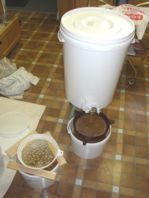
The result was a very light coloured, smooth tasting honey
which, true to the newsgroup's advice, soon began to set in the jars.
Then, on Saturday 5th June, Paul returned the "wet", extracted
honey supers to the hives at Flaxton ready for the bees to fill again
in Summer.
We now have our first supply of "Spring" flavoured honey.
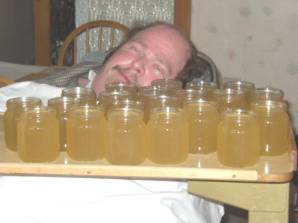
John dissapears: Note how light the honey is in colour
While he was collecting the honey from Flaxton Paul boxed up the swarm
he'd captured there in May into a full size brood box.
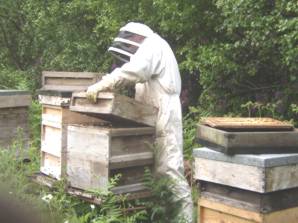
Paul returns the now empty supers to the bees at Flaxton
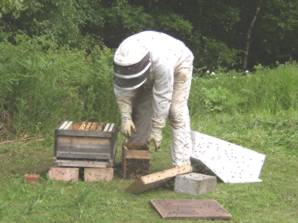
Transferring the swarm box to a fuill blown brood box
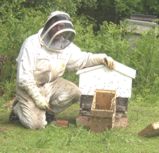
Finished
Our inspection of the bees here at Monk Avenue on 6th June showed both
hives 1 and 2 were producing queen cells so we removed one queen cell
to our smallest and weakest hived colony. Hopefully they will breed a
new queen.
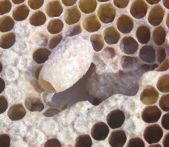
A queen cell
Another job during June was to move the swarm that we had caught earlier
in the year slowly into the apiary. Over the next few weeks Paul and Dad
moved the hive 3 feet a day until it was inside the apiary fence.
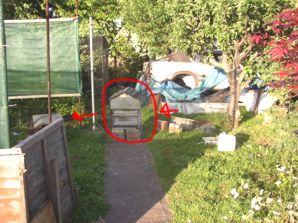
Moving the swarm: 3 feet per day to the apiary
John and Dad went to the annual Carers service at Selby Abbey on Sunday
13th leaving Paul to do the next inspection by himself. He found what
looked like a sealed queen cell in Hive 1. He destroyed it.
Had the bees already swarmed?
The new swarm was tidied into a new box with some frames of fresh wax.
But this swarm seems quite aggressive unlike our more docile, calm bees
so this will not do - we shall have to keep an eye on them!
On Sunday, 20th June our inspection of the colonies in hives 1and 2 had
well developed queen cells in them but there was lots of young brood and
eggs in Hive 1 so that hive could not have swarmed last week. The queen
cell in Hive 2 was now quite large so we split the hive again and put
the queen cells in a neucleus box near the main hive.
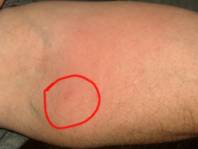
Dad got a bad sting on his arm from the agressive swarm