
September 2001
As September began we had to keep an eye on Dads queenless hive which we had united with one of the swarms at the end of August. We also had to decide what to do with the now queenless swarm in Lynn's garden. But we still hadn't to let this problem interfere with all our usual, main September jobs. September is usually a very busy month for all apiarists, we have to harvest all the honey from the hives and also make sure all our hives are intact and that the bees are all well fed with enough sugar syrup to last them through the Winter.
On September 1st we put clearer boards between the main hive boxes and
the honey Supers in hives 1 and 3 and removed the queen excluders.
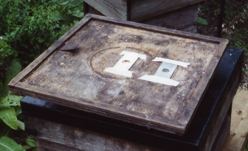
(A clearer board: Note the bee escapes that allow the
bees back down into the hives)
We hoped the bees would leave the honey supers and return
to the main body of the hive so that we could safely remove the honey
without disturbing them.
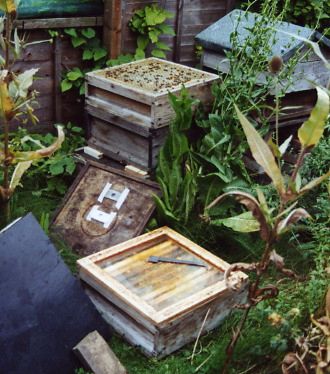
(Here hive3 has the super removed and we are about to replace the queen
excluder with a clearer board)
While we were doing this we aiso made sure all the hived swarms had a
"crown" or top board with a hole for a feeder in them.
All the colonies were very active and the bees seemed very edgy because
there were a few wasps around trying to raid the hives to steal the honey.
We made the hive entrances narrower to make it easier for the guard bees
to patrole them.
On Monday 3rd September we began feeding the swarms with lots of sugar
syrup to last them through the Winter and also added some strips of "Epistan"
medicine to the colonies to keep the dreaded Varroa mites away.
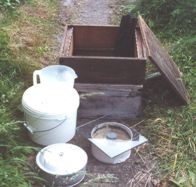
(Feeders and suger syrup at the ready)
It was getting late and the bees all seemed to have settled down so we
took the opportunity to remove the now cleaned supers off hives 1 and
3.
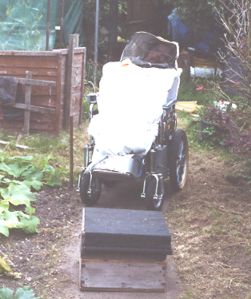
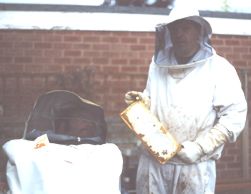
(John and the booty)
Altogether we had a total of 13 full supers of honey from our hives this
season!
But what shall we do with the swarm which hadn't a queen?
We decided to unite it with the swarm we had collected from Huntington
in July. We decided to use the newspaper uniting method. The swarm from
Huntington was a very powerful swarm and we had to spray syrup over the
hive with the queen in it. A layer of newspaper was then placed on top
and the queenless hive above it after it too had been sprayed with sugar
syrup, The bees would eat through the paper, start cleaning each other,
accepting the queen and mixing with the other colony's odour, thus uniting
the two hives.
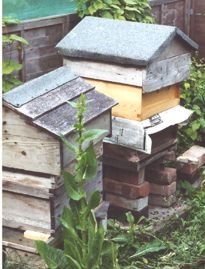
(Note the paper between the two colonies)
But back to the feeding of the colonies.
We continued topping the feeders up with sugar syrup to make sure they
had enough food to last them through the Winter.
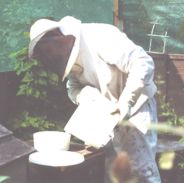
By mid September Paul had removed the last of the honey frames from Hive
2 and we were busy making up lots of sugar syrup for our main hives. We
gave each of our main 3 hives 4kg. of syrup and each swarm 2kg. of syrup.
Hopefully this will be enough to last them through the cold Winter months.
The last September job was to extract the honey from the super of frames
we'd removed from the hives. On Sunday 23rd September we took over the
kitchen sterilising all our equipment and spinning the honey from the
collected frames. First of all John and Dad cut the cappings from the
full frames of honeycomb ready for Paul to spin the honey from them in
the extractor - a very long, messy and exhausting job!
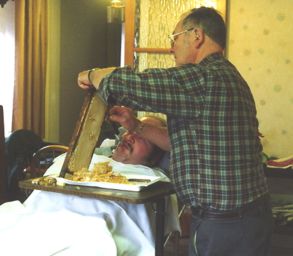
Dad and John de-cap the frames
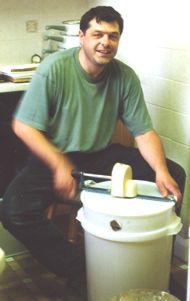
(And Paul spins it down.... Note his hand moves so fast it is but a blur)
Finally the honey was filtered through fine mesh into large plastic buckets,
two of which were filled completely to the brim this year. Each of these
large bucket holds about 25 lbs. so we should have about 50 lbs. of honey
this year.
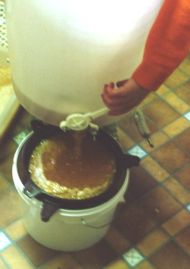
Filtering the golden honey