
June 2001
June - the month of many swarms: Or so it seems
to us.
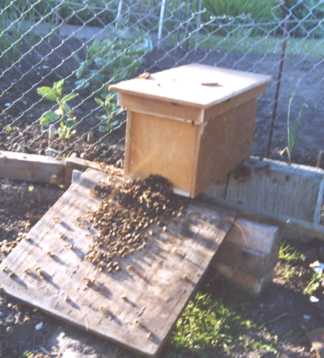
Hiving one of the many swarms:( Note all the bees running in to join the
queen)
The month of June was less than a day old when, on June 1st, Paul noticed
a swarm of bees had settled in the honeysuckle bush in our garden. He
was getting ready to go to work (bees never swarm when it is convenient
time) but they had to be dealt with - at least they had gathered in the
honeysuckle which was the same place to which a previous swarm had gone
in 1999.
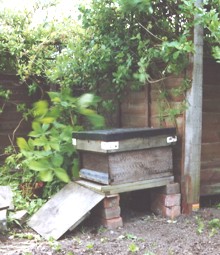
He set to work and collected the swarm, putting them in a box we had made
only a day earlier. Phew!
But why had the bees swarmed so early in the day? They usually swarm around
midday. Could the very changeable weather of the past few months have
anything to do with it? By lunchtime the weather had changed and it was
pouring with rain - can bees forecast the weather?
The next day, Saturday 2nd June, Paul inspected the new colony to see
if they were OK. To his astonishment he found all the swarm had left the
box and had settled underneath it!!
Why had they done this?
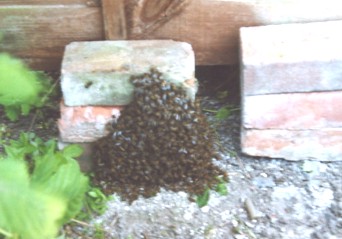
(Lift up the box and the bees are underneath)!
Perhaps he hadn't caught the queen,
So Paul and I spent the afternoon putting the swarm back into a proper
hive box - a new small, nucleus box which Dad had only made the day before!
On Monday, 4th Paul received a phone call at work to say that a swarm
had settled in our next door neighbour's hedge and he had to come home
again to deal with it. He managed to capture the swarm and put them in
one of the boxes we had prepared - so we now had our third swarm.
What are we going to do now?
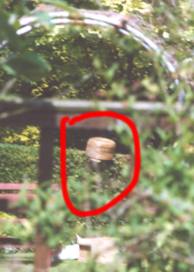
A long distance shot across to the neighbours hedge.
Old apiarists say that beehives can only be moved 3 yards or 3 miles
at a time - bees learn this vital information to tell where the hive is)
and get very confused when it is changed. Well, this swarm was only in
the neighbours garden!
Tuesday, 5th - Paul went to work as usual and things seemed quite peaceful
around the hives, until he got the phone call again from the same neighbour
who had reported the previous swarm. This time a larger swarm had settled
in their apple tree.
We had to use a step ladder to reach this swarm as well as all the usual
beekeepers' equipment to collect it.
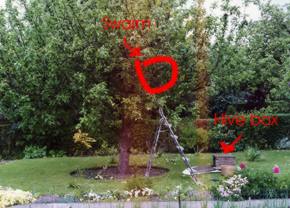
Lots of bees were still busy around hive 3. Could the swarm have come
from this hive ?
Because the bees have continued swarming Dad had to construct 4 more nucleus
boxes (small hive boxes containing 5 brood frames) to hold them. All these
boxes were soon used up.
(One of dads new nucleus boxes being pur to good use)
As all the swarms were in different areas of the garden and because hives
can only be moved 3 feet or 3 miles at a time, it was quite a long and
complicated job. Paul took one hive to Lynn's garden and swarm number
5 was moved from Lynn's to the house on Stockton Lane.
Over the next few days we moved hives to and fro like this, just to give
us some space.
On Wednesday, 6th June Paul received an e-mail message from us telling
him that hive 3 had tried to swarm again but Dad had managed to stop them
by spraying the hive with the hosepipe to simulate a shower of rain. The
bees returned to the hive.
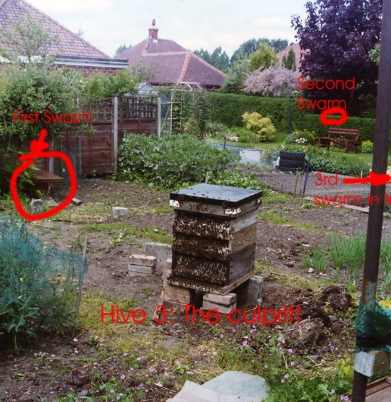
(Hive 3 in the centre with bees all up the front: It must
have been the source of all those swarms: The location of the swarms has
been ringed)
By Thursday 7th, the weather had deteriorated and so we thought the bees
wouldn't swarm for a while. We made up 10 new brood frames (the first
of nany this year) and Paul continued moving hives between Lynn's garden
and our bee enclosure.
On Friday 8th, Dad saw alot of bees flying around the garden but thought
there was nothing unusal about that. By Saturday, 9th however, everything
became clear. Paul found yet another swarm in the honeysuckle - the favourite
place for attracting swarms in our garden.
So we now had 5 swarms in total! We checked the hives we thought had swarmed
to see what they were like. There was still no brood in them.
Mum, Dad and John went to the annual Carers' Service at Selby Abbey on
Sunday, 10th June so Paul had time to check the bees thoroughly by himself.
He found yet another swarm on the ground near the now famous honeysuckle.
Oh no, here we go again!
With no more mini hive boxes to spare Paul added the bees to an existing
swarm near thn honeysuckle and hoping all would be OK left the two queens
to fight it out.
Looking into hive 3 (the prime suspect for all these swarms) he fonnd
several queens were just hatching so he put them in some other boxes.
A summary:
Hive 1 - contained some brood and was picking up slowly.
Hive 2 - no brood, but 1 open queen cell found. This could be one from
the first swarm we collected.
Hive 4 - this, our first swarm still had no brood.
I hope these hives start improving soon!
On Monday 18th June we checked all the swarms again.
There was still no brood in any of the hives so we closed them all up
and left them for a while.
It was not until 30th June that we inspected these hives again. This time
there were 3 apiarists in the beekeeping team. Dad had started his Beekeepers'
evening classes and was now part of the inspection team.
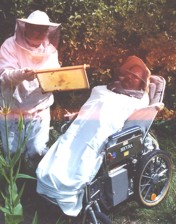
This is what we found.
Hive 1 - colony now much improved. We found and removved 14 queen cells
in this hive.
Hive 2 - some capped brood cells were found so this colony must be slowly
increasing.
Hive 3 - some frames of capped honey removed. We didn't look into the
brood chambers as these bees had already swarmed several times.
Hive 4 - we saw a few cells already had eggs in them - I hope these are
fertile.
Hive 6 - this colony is very small and weak. I don't know if this swarm
will survive.